NC-ORG-M-GOLD-ONE-i-25-01
work completed on January 11, 2025
1st owner: Yury G (Italy)
Monograph
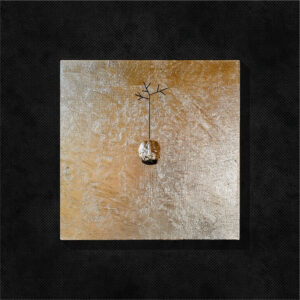
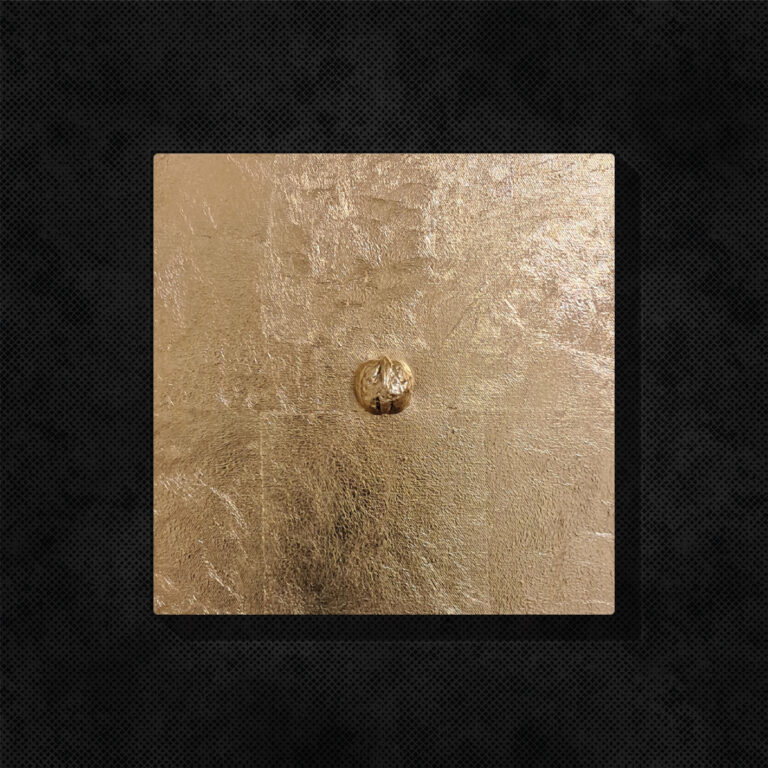
The Gold One Walnut offers a perfect visual synthesis of philosophical, scientific, and spiritual inquiries into the nature of essence.
Through matter and form, the artist renders the invisible quidditas of the human being tangible.
The Symbolism of Matter: Gold and the Absolute
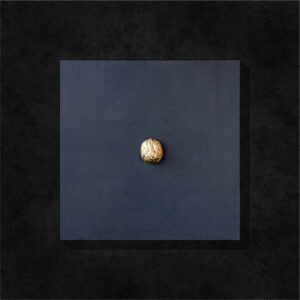
The choice to represent the walnut in gold, set against a golden background, elevates the object from its fleeting biological nature to its eternal ontological nature.
Theologically, gold is the color of the incorruptible and the divine. Representing the human essence through this material evokes the Imago Dei: the core of every individual is precious, sacred, and a participant in divine nature. It is not merely a walnut destined to decay, but an eternal idea.
Metaphysically, gold annuls space and time. The walnut is suspended in an infinite dimension, suggesting that our true essence resides outside the temporal circumstances of daily life.
Morphology: The Shell and the Inner Mystery
The very shape of the walnut serves as a perfect metaphor for the dualism between Existence and Essence.
The Shell (Existence): A rough, hard surface representing our existence in the world, the defenses we build, the persona (mask) we show to society, and the matter that withstands the shocks of life. It is what is visible “on the outside.”
The Kernel (The Hidden Essence): What the walnut jealously guards within is the vital seed. The question “How much have you lived in your essence?” alludes precisely to the difficulty of breaking the shell of the ego and social conventions to access the nourishing, authentic inner truth.
The Sprout: Potency and Act
The interpretation of the work as a “seed seeking answers in order to sprout” connects directly to the Aristotelian dynamics of Potency and Act and the scientific vision of DNA.
A closed walnut is pure potency. It contains within it, compressed, the entire majesty of the tree, yet it is not yet the tree. “Seeking answers” is the metaphor for germination. To sprout, the seed must “interrogate” the soil to find the right conditions. Beyond the metaphor, the human being must interrogate their own life to find the fertile ground where their essence can manifest.
To sprout means to break the closed perfection of the golden shell. Living in one’s essence requires the courage to “break,” to abandon the stasis of potential perfection to risk the imperfection of real growth.
The Golden Self: A Jungian Journey into the Walnut
Imagine standing before an expanse of gold. It is not a void, but a dense space, an Unus Mundus, that unified world described by Carl Jung where psyche and matter merge. At the center of this golden universe, suspended like a star in a still galaxy, lies a walnut.
At first glance, we see matter and philosophy: pure essence, the Aristotelian Quidditas, removed from time and fixed in eternal perfection. But if we allow our gaze to sink beneath the surface, we feel the shadow of Jung approaching, recognizing the supreme archetype in this small object: the Self (Selbst).
The walnut, in its sphericity and completeness, is a three-dimensional mandala. It represents the totality of the psyche, the union of opposites, the organizing center that encompasses both our luminous consciousness and our abyssal unconscious. By wrapping it in gold, the artist has performed an alchemical act: transforming base matter into the Lapis Philosophorum, the Philosopher’s Stone. This walnut is no longer just a fruit; it is the “hard-to-reach treasure,” the ultimate goal of human existence.
However, the drama of the work lies in its structure. Look at the shell. It is rigid, sculpted, brilliant. In Jungian terms, this is the Persona: the social mask we wear to adapt to the world. It is the part of ourselves we polish daily, the image we show to others to protect our intimacy. Often, we spend our entire lives identifying with this golden shell, believing ourselves to be our profession, our status, or our reflected image. But the shell, however magnificent, is static. It is a golden prison.
Inside, invisible yet present, lies the kernel, the seed. Here resides the authentic essence, the unexpressed potential, and what Jung would call the Unconscious. It is the place of mystery, the dwelling of our destiny’s code, our daimon.
The question “How much have you lived in your essence?” thus becomes: how much have you remained trapped in the Persona, forgetting to nourish the Soul that lives within?
The work describes the walnut as a “seed seeking answers in order to sprout.” In Jungian terms, this desire to sprout is the Process of Individuation. It is the imperative psychological drive to become who one truly is, integrating the hidden parts of ourselves to achieve wholeness.
But there is a price to pay, and this is where the work becomes poignant. To sprout, the seed must break the shell. The individual must have the courage to crack their own Persona, to let the external certainties and the carefully constructed golden defenses fall away. One must accept the chaos of growth to liberate the Self.
The golden walnut watches us and questions us silently. It asks if we are willing to sacrifice the apparent perfection of our shell to undertake the dangerous and sacred journey toward our true nature. It reminds us that essence is not a trophy to be admired on a wall, but a living force pressing from within, demanding to break the form to become Life.